
Why You Should Choose Your Smart Home Integrator — Not Just Accept Your Builder’s
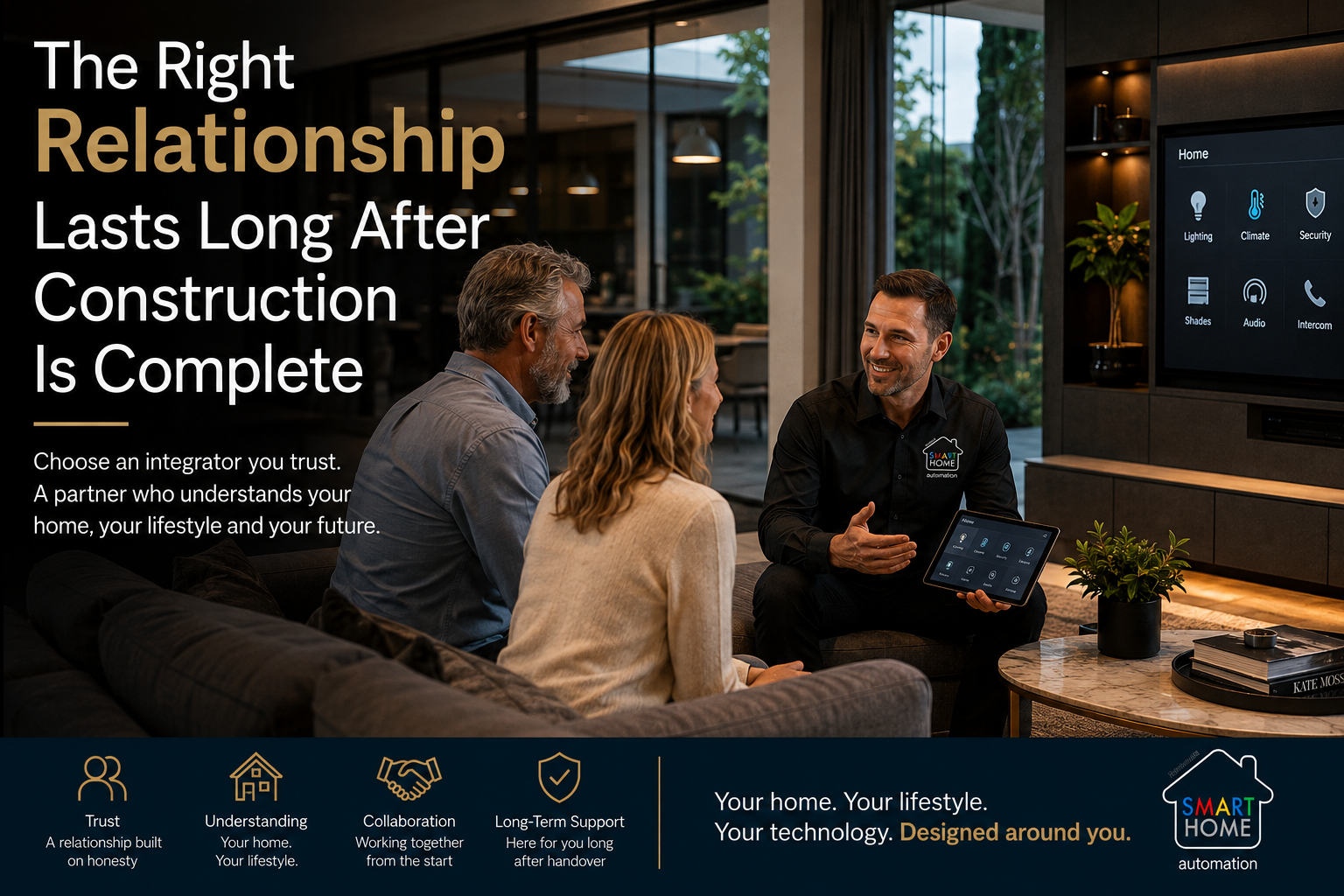
When building or renovating a high-end home, you carefully choose the people responsible for bringing it together.
You choose an architect whose design philosophy you understand.
You choose an interior designer whose style you trust.
You choose a builder you believe can deliver the quality of home you expect.
So why should the technology integrator be any different?
Technology is becoming part of the fundamental infrastructure of the modern home. Lighting control, automation, networking, Wi-Fi, security, CCTV, intercoms, access control, audio, televisions, climate control, blinds and other systems increasingly need to operate together.
The company responsible for designing and integrating that technology can have an enormous influence on how your home functions every day.
And unlike many contractors involved during construction, your relationship with your technology integrator will often continue long after the builder has handed you the keys.
That makes choosing the right integrator important.
Your Builder's Integrator May Be Excellent — But You Should Still Meet Them
Many quality builders have technology integrators they regularly work with.
There are good reasons for this.
Established relationships can improve communication, coordination and construction efficiency. An integrator who understands the builder's processes can make delivering a complicated project considerably easier.
We work closely with builders, architects, interior designers, electricians and other consultants for exactly this reason.
But there is an important distinction.
A good working relationship with the builder doesn't automatically mean the integrator is the right fit for the homeowner.
Before accepting the technology company proposed for your project, meet them.
Talk to them.
Understand their capabilities.
Ask how they approach design.
And determine whether you are comfortable trusting them with the technology that may operate your home for the next decade or more.
Every Home Is Different Because Every Client Is Different
There should never be a standard technology package for a custom home.
Two houses can have similar floor areas, construction budgets and architectural styles while requiring completely different technology solutions.
One family might place enormous importance on music and entertainment.
Another might prioritise security, CCTV and controlled access.
Someone working extensively from home may consider network performance and internet redundancy critical.
Another client might want sophisticated lighting and automated blinds.
Some homeowners love technology and want extensive control and customisation.
Others don't want to see the technology at all.
They simply want everything to work.
Neither approach is wrong.
The technology should adapt to the people living in the house — not the other way around.
The First Question Shouldn't Be “Which Automation System Do You Want?”
Before discussing brands, processors, touchscreens or equipment racks, an integrator needs to understand the client.
How do you use the house?
How does your family live?
How do you entertain?
Which rooms matter most?
What frustrates you about technology?
What would you like to happen automatically?
How important is security?
Do you want physical switches, touchscreens, apps, voice control or a combination?
What technology do you already enjoy using?
What don't you want?
And what might your requirements look like five or ten years from now?
Only once those questions have been answered should the technology solution begin taking shape.
Good smart home design starts with a conversation, not a product catalogue.
Know Who Is Actually Designing Your Home
This is particularly important on larger projects.
Find out who will actually be responsible for your technology.
Who is designing the system?
Who is programming it?
Who commissions it?
Who will explain it to you?
And most importantly:
Who are you going to call after you move in?
You may be dealing with that company for many years.
Technology changes.
Families change.
Rooms get renovated.
Televisions are replaced.
Internet services change.
New security requirements arise.
Automation gets modified.
Equipment eventually reaches the end of its useful life.
The company designing your home today may become your technology partner well into the future.
You should know who those people are.
You Need to Trust Your Integrator
A significant amount of trust is involved in designing a sophisticated smart home.
Most homeowners aren't expected to understand the technical differences between networking equipment, automation processors, lighting protocols, surveillance platforms or audio distribution systems.
That's why you're employing a specialist.
But that also means you need confidence in their advice.
Sometimes the right recommendation is to spend more.
Sometimes it is to spend less.
Sometimes a feature that sounds impressive in a showroom adds very little value to your particular home.
Sometimes something hidden inside a communications rack that you will rarely see is actually one of the most important investments in the entire system.
A good integrator should be comfortable having those conversations.
Their responsibility isn't to put the maximum amount of technology into your house.
It is to put the right technology into your house.
Your Integrator Should Understand the Whole Technology Ecosystem
Home automation is only one component of a modern integrated home.
Your integrator should understand how all the major technology disciplines interact.
That includes:
Home automation
Lighting control
Wired and wireless networking
Security and alarm systems
CCTV
Intercoms
Access control
Multi-room audio
Television and video distribution
Home cinema
Automated blinds and curtains
Heating and cooling integration
Energy management
Remote access and monitoring
No individual manufacturer is necessarily the best at every one of these things.
The role of the integrator is to understand the available technologies and determine which combination makes sense for the project.
Knowing how to install one automation platform doesn't automatically make someone an expert in integrated home technology.
Don't Let the Integrator's Knowledge Limit Your Home
This is an important question homeowners rarely ask:
“Are you recommending this technology because it's the best solution for my home — or because it's the only solution you know?”
There is nothing wrong with an integrator having preferred products.
Experience matters.
Using proven equipment can improve reliability and allows technicians to develop deep expertise.
We have products and platforms we prefer for exactly those reasons.
But preference should never replace knowledge.
A capable integrator should understand alternative technologies and be able to explain why one solution has been selected over another.
They should also be willing to investigate something outside their normal product range when the project requires it.
Sometimes they may advise against it.
That's fine.
But the reasoning should be based on compatibility, reliability, functionality, serviceability or another genuine technical consideration.
Your home's capabilities shouldn't be limited by the limits of your integrator's knowledge.
Your Integrator Should Be Willing to Challenge You
Choosing your integrator doesn't mean finding someone who agrees with everything you ask for.
In fact, the opposite is often true.
A good integrator should tell you when an idea is unnecessarily complicated.
They should identify technology that isn't providing meaningful value.
They should warn you when a decision may create limitations later.
They should identify areas where spending more now could prevent expensive changes during or after construction.
And occasionally they should simply say:
“You don't need that.”
That's part of being a trusted adviser rather than simply an equipment supplier.
Your Builder and Integrator Should Work Together
Choosing your technology integrator shouldn't mean creating conflict with your builder.
Quite the opposite.
The best projects happen when the homeowner, architect, builder, interior designer and technology integrator work collaboratively from the beginning.
Technology affects many parts of construction.
Equipment locations need planning.
Lighting control affects electrical design.
Automated blinds require coordination with window treatments and joinery.
Speakers affect ceilings.
Intercoms and access control affect doors and gates.
Televisions affect cabinetry and wall construction.
Wi-Fi access points need appropriate locations.
CCTV cameras need to be considered alongside architecture.
Communications racks need adequate space, ventilation and power.
These decisions are much easier — and usually less expensive — when the technology integrator is involved early.
The integrator shouldn't compete with the builder. They should become part of the team.
Think Beyond Handover
During construction, everyone's attention is naturally focused on completion.
But handover isn't the end of your relationship with the technology in the home.
It's the beginning.
Five years later, the builder may have moved on to dozens of other projects.
You will still be living with the technology.
Ten years later, parts of that technology may need upgrading.
You might renovate.
Your children may grow up.
Your security requirements may change.
New technologies will emerge.
The system should have been designed with those possibilities in mind.
More importantly, you should know who you can call when that happens.
Ask Questions Before You Make Your Decision
Before selecting a technology integrator, have a proper conversation with them.
Ask about their experience.
Ask what technologies they work with.
Ask how they decide which products to recommend.
Ask how they approach networking and cybersecurity.
Ask who handles programming.
Ask what documentation you receive.
Ask what happens after handover.
Ask how upgrades are handled.
Ask whether the system can evolve.
And ask them to explain their recommendations in language you understand.
A good integrator shouldn't be uncomfortable with those questions.
They should welcome them.
Choose the People Before You Choose the Products
It's easy to become focused on brands when researching smart home technology.
But ultimately, the people designing and integrating those products matter enormously.
The best equipment in the world can deliver a frustrating experience when it is poorly designed, programmed or supported.
Conversely, an experienced integrator can take technologies from multiple specialist manufacturers and make them operate together so naturally that the homeowner barely thinks about the complexity behind them.
That's the objective.
A truly intelligent home shouldn't feel complicated.
It should simply feel like the home understands how you live.
So if your builder recommends a technology integrator, absolutely consider them.
They may be an excellent choice.
But don't select them simply because they're the builder's preferred contractor.
Meet them.
Question them.
Understand them.
Make sure their approach aligns with yours.
Make sure they have the technical knowledge to design the home you want.
And make sure you're comfortable calling them years after construction is finished.
Because you're not simply choosing someone to install technology during your build.
You're choosing the people you will trust with your home's technology for years to come.
Peninsula Smart Home Automation
Smart home technology designed around the client — not a standard package.
Peninsula Smart Home Automation designs, integrates and supports intelligent home technology throughout Melbourne, Bayside and the Mornington Peninsula.
We work collaboratively with homeowners, builders, architects, interior designers and other consultants to design technology around the individual requirements of each home.
Our experience spans home automation, lighting control, networking, Wi-Fi, security, CCTV, intercoms, access control, multi-room audio, video, home cinema, automated blinds and integrated environmental systems.
If you're planning a new home or major renovation, involve your technology integrator early.
The best time to make technology decisions is before construction makes those decisions difficult — or impossible — to change.