
AI and Smart Home Automation: How the Intelligent Home Is Evolving
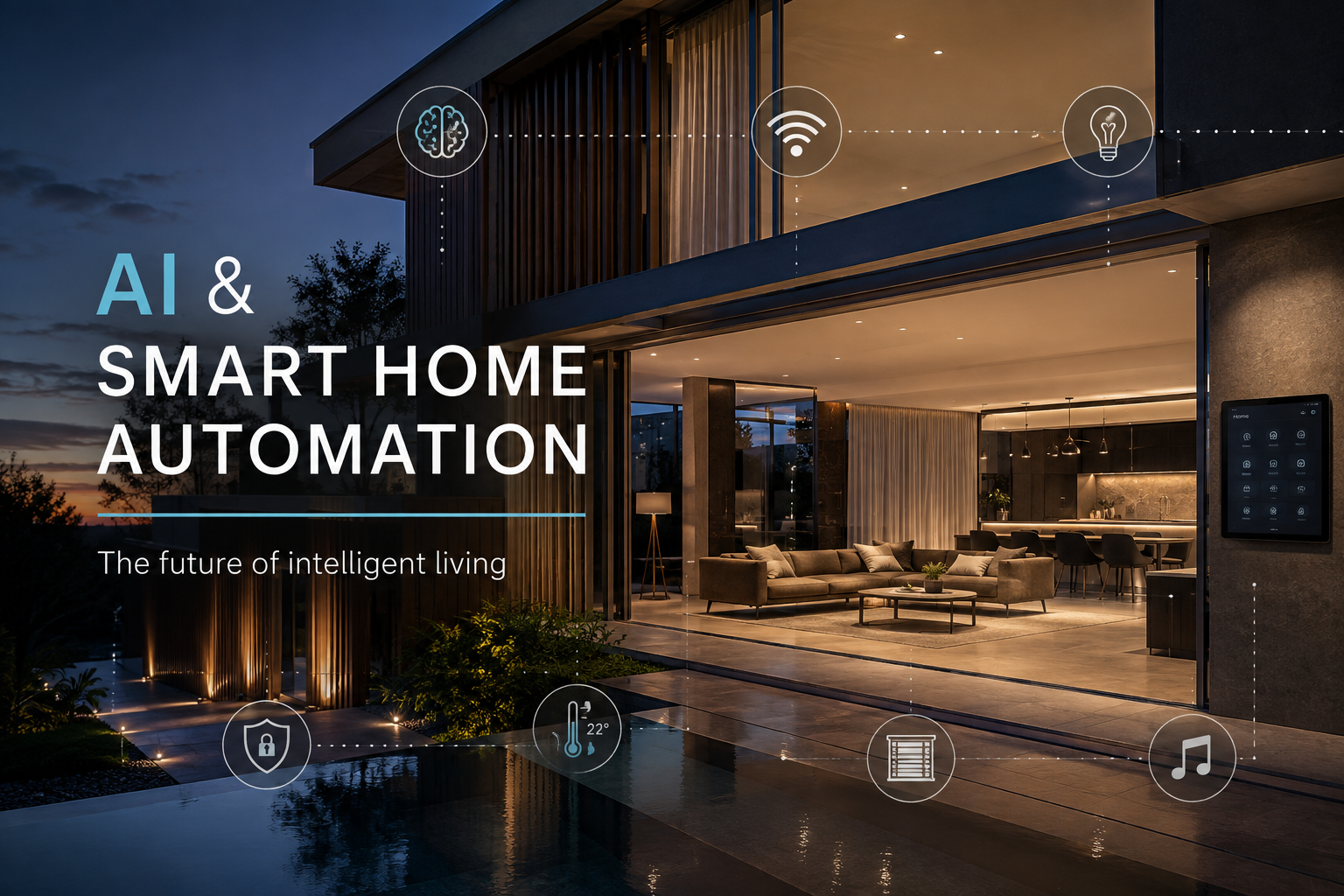
Artificial intelligence is changing the way we interact with technology, and the smart home is one of the areas where that change is becoming increasingly noticeable.
For years, home automation has allowed homeowners to control lighting, climate, security, entertainment, blinds and other systems from touchscreens, apps, schedules and automated scenes.
AI adds another layer.
Instead of a home simply responding to commands, AI is beginning to help smart homes understand patterns, interpret natural language, identify unusual activity and make better decisions based on what is happening around the home.
Smart Home Automation vs AI
Traditional home automation is generally based on programmed actions.
Press a button and the lights dim, the blinds close and the television turns on.
Leave the house and an "Away" scene can switch off selected lighting, adjust the air conditioning, turn off entertainment systems and arm the security system.
These automations are extremely reliable because the home has been specifically programmed to behave in a particular way.
AI introduces the ability to analyse information and adapt.
The best smart homes of the future won't replace traditional automation with AI. Instead, they will combine the reliability of professionally programmed automation with the intelligence and flexibility of AI.
Natural Language Is Changing How We Control Our Homes
Voice control has been available in smart homes for years, but AI is making the interaction far more natural.
Rather than memorising specific commands, homeowners will increasingly be able to speak normally.
For example:
"Make the living room comfortable for watching a movie."
An integrated system could interpret that request and coordinate the lighting, blinds, television, audio and climate systems.
The important part is what happens behind the AI.
A professionally integrated automation platform still provides the reliable connection between the different systems throughout the property. AI simply provides a more intelligent way of interacting with them.
AI-Enabled Security and CCTV
Security is already one of the strongest examples of AI being used in modern homes.
Modern surveillance cameras can use analytics to distinguish between people, vehicles and other movement. More advanced systems can use object classification, behavioural analysis and intelligent searching to help homeowners find important events without manually reviewing hours of footage.
Instead of receiving an alert every time a tree moves in the wind, a properly configured system can concentrate on events that actually matter.
When CCTV, access control, intercom and alarm systems are integrated with the wider smart home, even more becomes possible.
For example, an integrated home could respond differently depending on whether someone approaches the front door, a vehicle enters the driveway or movement is detected around the property while the security system is armed.
A Home That Learns How It Is Used
One of the most interesting opportunities for AI is understanding how a home is actually being used.
Lighting, temperature, occupancy and energy consumption all generate useful information.
Over time, intelligent systems can potentially identify patterns and make recommendations based on them.
The system might recognise that certain rooms are rarely occupied during particular periods, that heating or cooling is operating unnecessarily, or that the family regularly performs the same sequence of actions at a particular time.
Instead of automating everything automatically, AI can also suggest improvements.
That distinction is important.
In a well-designed smart home, homeowners should remain in control. AI should make the home easier to use rather than creating unpredictable behaviour.
Smarter Climate and Energy Management
Climate control is another area where AI and automation work particularly well together.
A conventional automation system can already coordinate heating, cooling, blinds, temperature sensors and occupancy.
Adding intelligent analysis allows the system to consider more information.
Future systems may increasingly take into account occupancy patterns, outside temperature, weather forecasts, solar exposure and previous heating or cooling performance.
Motorised blinds could reduce heat entering western-facing rooms before the temperature becomes uncomfortable, while climate systems could concentrate on occupied areas rather than conditioning an entire property unnecessarily.
The result isn't simply convenience. Intelligent integration also has the potential to improve energy efficiency.
Entertainment Becomes More Personal
Whole-home audio and video systems are also becoming more intelligent.
AI-powered search and recommendation systems are already changing how people discover music, movies and television.
When combined with a professionally integrated smart home, accessing that content becomes much simpler.
A homeowner shouldn't need to understand which amplifier, television input or audio zone needs to be selected.
They should simply choose what they want to watch or listen to and where they want it.
The automation system handles the technology behind the scenes.
This is where good smart-home design becomes almost invisible.
Why Proper Integration Still Matters
There is an important distinction between a collection of smart products and an integrated smart home.
Adding AI to individual devices doesn't automatically make a property intelligent.
You can have a smart television, smart lights, smart speakers, cameras, air conditioning apps and motorised blinds and still end up with six different apps and systems that don't communicate properly with each other.
Professional integration provides the foundation that connects those technologies.
Platforms such as Savant, together with integrated lighting control, networking, security, CCTV, intercom, climate, audio and video systems, can provide a central architecture for the home.
AI can then sit above or alongside that infrastructure and make the overall system easier and more intelligent to use.
The Network Becomes Even More Important
As homes become increasingly connected, the network supporting them becomes critical.
AI-enabled cameras, streaming services, automation controllers, touchscreens, wireless devices and cloud services all rely on stable connectivity.
For this reason, commercial-grade networking and proper Wi-Fi design are becoming fundamental parts of modern smart-home projects.
The smartest equipment in the world isn't very smart when the network supporting it is unreliable.
Privacy and Security Need to Be Considered
AI also introduces legitimate questions about privacy and cybersecurity.
Homeowners should understand which information remains inside the property and which information is processed by external cloud services.
This makes system design increasingly important.
Network security, device management, remote access and the selection of reputable technology platforms should be considered during the design stage rather than after the home has been completed.
For high-end residential projects in particular, cybersecurity should be treated as part of the home's technology infrastructure.
What Will the AI-Powered Smart Home Look Like?
The biggest change may be that technology becomes less visible.
Instead of constantly opening apps or navigating control screens, homeowners will increasingly interact with their homes naturally.
The home will already understand the status of its lighting, climate, security, entertainment and other integrated systems.
AI provides another way to interpret what the homeowner wants and potentially anticipate what they may need next.
But the objective shouldn't be to put AI into a house simply because AI is fashionable.
The objective is a home that is simpler to operate.
Technology should disappear into the background.
Why AI Makes Early Smart Home Planning More Important
As artificial intelligence becomes more integrated into residential technology, early planning between the homeowner, architect, builder, electrical contractor and smart home integrator becomes increasingly important.
Many of the technologies that will support the intelligent home of the future depend on decisions made long before the homeowner moves in.
Structured cabling, equipment locations, communications racks, lighting control architecture, network infrastructure, security devices, motorised blinds, audio zones and control interfaces all need to be considered during the design and construction process.
Trying to introduce these systems after plaster, joinery and architectural finishes have been completed can significantly limit the available options.
For architects and builders working on high-end residential projects, involving a technology integrator early allows the home's technology infrastructure to become part of the architectural and electrical design rather than something added at the end of construction.
The individual AI technologies will continue to evolve.
The infrastructure supporting them needs to be designed correctly from the beginning.
Designing Homes for What's Coming Next
For architects, builders and homeowners planning a new home or major renovation, the important decision isn't which AI assistant happens to be popular today.
Those products will continue to change.
The more important investment is creating the infrastructure that allows the property to evolve.
Structured cabling, a professionally designed network, integrated lighting control, security, CCTV, access control, audio, video, climate integration and a capable automation platform create the foundation.
AI can evolve on top of that foundation.
A well-designed smart home shouldn't be designed around today's technology alone. It should be designed so that new technologies can be incorporated as they become available.
Building Smarter Homes in Melbourne and the Mornington Peninsula
At Peninsula Smart Home Automation, we design and integrate technology systems for residential projects across Melbourne, Bayside and the Mornington Peninsula.
Our approach is to bring the home's technology together as one coordinated system rather than a collection of separate products.
From Savant home automation and integrated lighting control through to networking, CCTV, security, intercoms, access control, multi-room audio, television, climate control and motorised blinds, the objective is always the same:
Make sophisticated technology simple to use.
AI is going to make smart homes considerably more capable.
But the homes that benefit most will be the ones with the right infrastructure and integration already in place.
That's why the intelligent home of the future starts with good design today.