
Does a Bigger Dealer Network Mean a Better Smart Home?
When choosing a home automation system, one of the selling points you will often hear is the size of the dealer network.
Thousands of dealers. Global distribution. Products available everywhere.
That can sound reassuring.
But when it comes to a professionally designed smart home, a larger dealer network does not automatically mean a better dealer network — or a better result for your home.
The Integrator Matters as Much as the Control System
Systems such as Control4 have built very large international dealer networks. There are certainly experienced and highly capable Control4 dealers within that network, but the sheer number of dealers also means the standard of design, installation, programming and ongoing support can vary considerably from one integrator to another.
Unfortunately, poor installations can damage the reputation of the technology itself.
When a homeowner says, “I had Control4 and it was terrible,” was the underlying problem actually Control4?
Sometimes it may have been.
But sometimes the real problem was the way the system was designed, installed, programmed or supported.
The same principle applies to almost every professional automation platform.
The technology is only as good as the people designing and implementing it.
The Problem With Sales-Driven Dealer Models
There is another issue homeowners rarely see: the commercial relationship between an integrator, manufacturer and distributor.
Professional technology brands can operate dealer programs with purchasing targets, dealer tiers, volume-based pricing and other commercial incentives.
There is nothing inherently wrong with this. Volume purchasing exists throughout almost every industry.
The problem begins when those incentives influence the design of the home.
If an integrator receives better commercial terms by purchasing more products through a particular manufacturer or distributor, there is an obvious incentive to keep specifying products from that ecosystem.
That might be good for the integrator's purchasing position.
But is it necessarily the best solution for the client?
Those are two very different questions.
Your Home Shouldn't Be Designed Around a Distributor's Catalogue
A luxury home contains many different technology categories:
Lighting control
Home automation
Networking and Wi-Fi
Audio
Video
Security
CCTV
Intercom
Access control
Heating and cooling integration
Blinds and curtains
It is extremely unlikely that one manufacturer — or one distributor's collection of brands — produces the best solution in every category.
So why design a home as though they do?
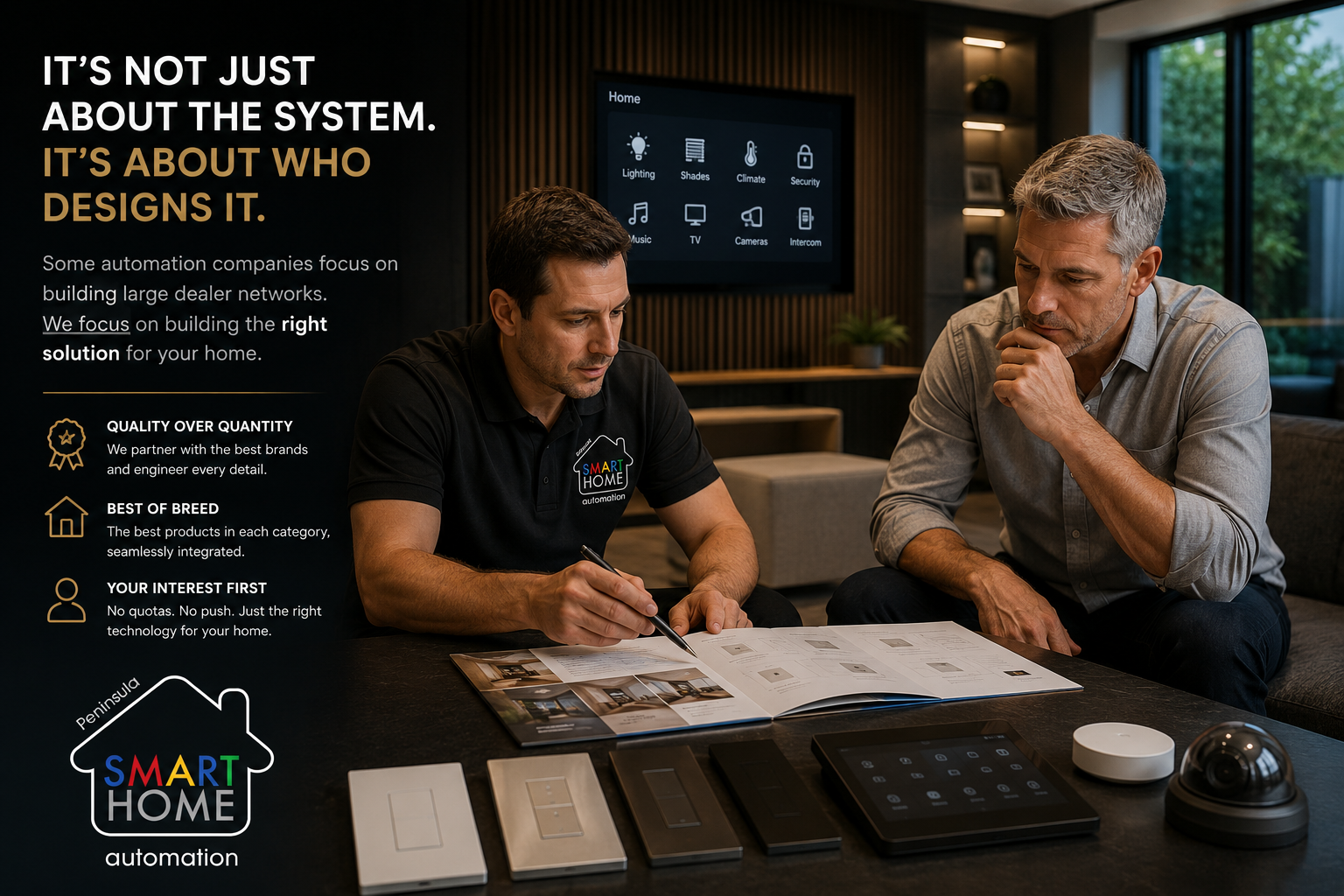
At Peninsula Smart Home Automation, our philosophy is different.
We believe the control system should bring the technology together — not dictate every product that goes into the house.
We look at each category individually and determine which product or platform is best suited to the project.
The lighting system might come from one specialist manufacturer.
The networking from another.
Security from another.
Audio from another.
The automation platform then becomes the layer that brings those systems together and gives the homeowner a simple, consistent way of controlling the entire home.
Best of Breed, Then Integrate
This is what we mean by a best-of-breed approach.
We don't believe a client should be pushed toward a particular product simply because it helps an integrator achieve a purchasing target, dealer status or better buying price.
The questions should be:
What is the best product for this application?
Is it reliable?
Can it be supported long term?
Does it integrate properly with the rest of the home?
And most importantly — is it the right solution for this client?
Only after answering those questions should a product be specified.
Choose the Integrator Before You Choose the Logo
When comparing smart home systems, don't simply ask how many dealers a manufacturer has.
Ask who will actually be designing your home.
Ask what other platforms they work with.
Ask whether they are willing to recommend products outside their preferred ecosystem.
Ask why each major product has been specified.
And ask whether their recommendations would change if there were no dealer targets, purchasing incentives or distributor relationships involved.
A good integrator should be able to answer those questions confidently.
Because ultimately, you aren't buying a collection of logos.
You're trusting someone to design a technology platform that may remain in your home for the next 10, 15 or 20 years.
Choose an integrator who is prepared to select the right technology for your home — and then make all of it work together.